Hefesto
A daily wildfire ignition-risk modeling system for Goias, Brazil, built around versioned data, climate signals, and reproducible evaluation.
Role: Data modeling, pipeline design, validation, and documentation
Problem
Daily wildfire ignition risk needs comparable results across climate, dryness, vegetation, and historical conditions.
Constraint
A model improvement is not useful if its data, assumptions, and evaluation cannot be reproduced or explained.
Decision
Treat the research pipeline as a product with schema contracts, manifests, experiment profiles, registry entries, and diagnostics.
Outcome
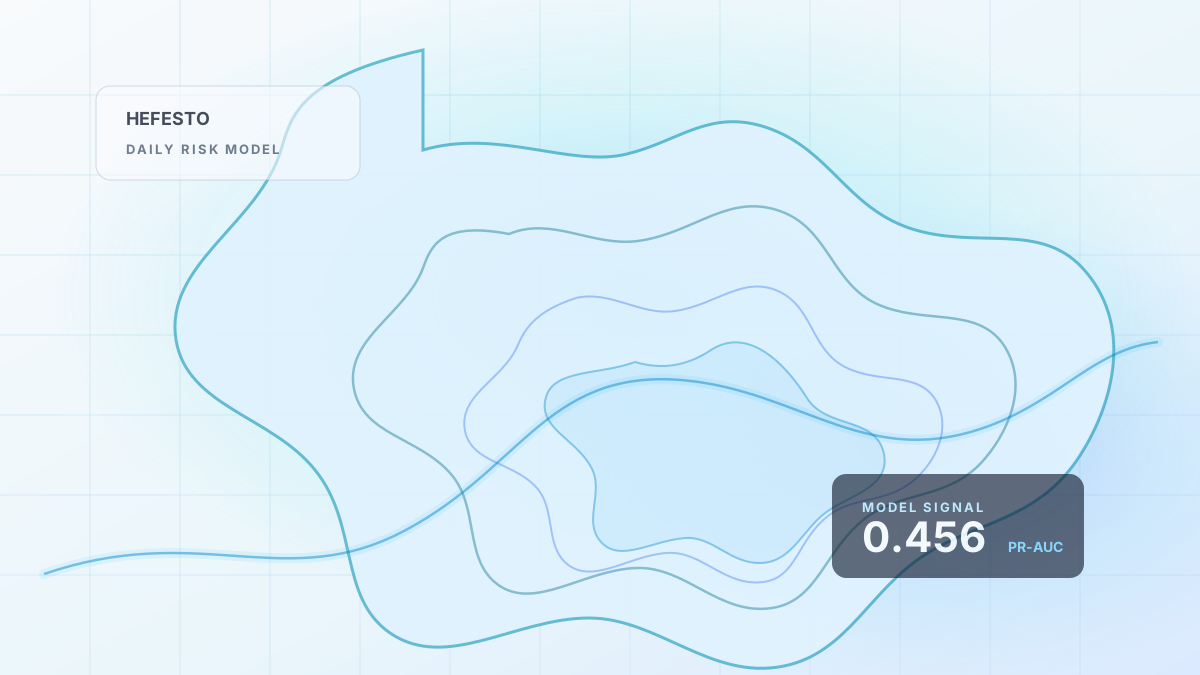
The materialized climate and MODIS line improved PR-AUC from 0.407 to 0.456 while preserving an auditable path forward.
1 km
Grid
0.456
Best PR-AUC
v2-v8
Roadmap
Overview
Hefesto is a wildfire ignition-risk modeling project focused on Goias, Brazil. The work is less about a single model artifact and more about building a disciplined research system: repeatable datasets, versioned experiments, meaningful diagnostics, and a clean record of what changed.
The public-facing story stays intentionally safe. It explains the modeling architecture and impact without exposing private operational paths, credentials, or deployment details.
Modeling Shape
The project works on a daily 1 km grid and compares experiment lines across fixed evaluation rules. The strongest materialized line adds climate antecedents, dry-window signals, nearest-station assignments, and MODIS-derived information.
The main quality gain came from treating the pipeline as a product: schema contracts, manifests, named versions, frozen baselines, registry entries, and diagnostics that make every result explainable.
What I Built
- Versioned experiment profiles from baseline through climate and MODIS feature lines.
- Dataset manifests and validation checks to keep results comparable.
- XGBoost modeling workflows with PR-AUC tracking across versions.
- Calibration and diagnostic reporting for temporal and regional behavior.
Outcome
The model line improved from a v3.0 PR-AUC of 0.407 to a v5.0 PR-AUC of 0.456. More importantly, the project now has enough structure to keep improving without losing the thread of why each experiment changed.